
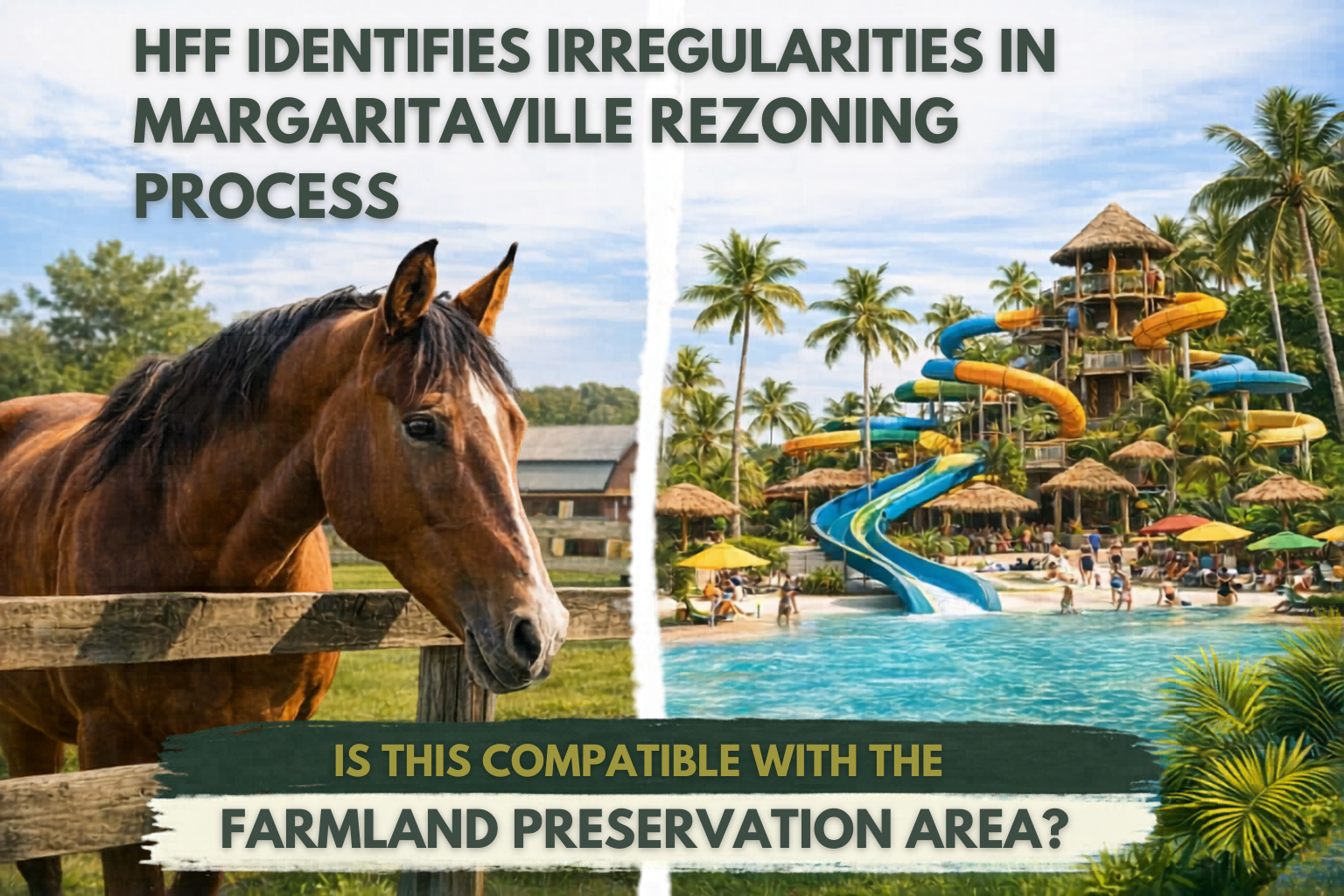
On February 17th, the Board of County Commissioners voted 4-to-1 to allow 8M Holdings to amend their zoning from an RV park with private amenities to an RV park with public amenities that allows for a Margaritaville-themed amusement park with alcohol sales and live entertainment. This approval includes daily admission for a fee.
Horse Farms Forever® opposed the amendment as it modified uses within a pre-existing PUD to introduce intense and incompatible uses inside the Farmland Preservation Area.
Horse Farms Forever’s Commitment to Transparency and Facts
Horse Farms Forever® works hard to stay true to its mission statement and follow a consistent, transparent and fact-based protocol when dealing with land use conflicts. For this reason, we surround ourselves with elite professionals to assure the accuracy, integrity and credibility of our land use position statements.
First and foremost, HFF maintains the position: When presented with the facts, we trust our elected commissioners to make decisions that are in the best interest of the community. However, our concern with the decision made to approve the Margaritaville RV Park rezoning is the failure in the integrity of the approval process.
Understanding the Rezoning Review Process
A zoning application is heard at a quasi-judicial public hearing. Quasi-judicial hearings require the applicant, not the county, to demonstrate that the rezoning is consistent with the local government’s comprehensive plan and all substantive and procedural requirements of the zoning ordinance. The applicant provided no such evidence on the application and therefore failed to clear this required hurdle. As this initial burden was not met, the county should have rejected the application outright. Instead, it accepted the flawed application and proceeded to process and approve it.
When it comes to land use and zoning applications, the commissioners rely on the county’s Growth Services Department to review the facts and circumstances relating to an application and present them in a staff report. The staff report explains how those facts align with the controlling and governing documents: the county’s comprehensive plan, the land development regulations and the Florida statutes and administrative code. The commissioners then consider the application, the staff report and any other competent and substantial evidence presented at the public hearing.
Concerns With the Staff Report and Supporting Evidence
The Growth Services staff report, when prepared by a member of the American Institute of Certified Planners (AICP), is deemed competent and substantial evidence that the commissioners can consider when making their quasi-judicial decision. The staff report should be complete, unbiased and sustainable when subjected to peer review.
The Growth Services staff report for the Margaritaville RV Park application, which recommended approval of the application, was incomplete and factually flawed, and therefore contrary to the requirements and standards of the AICP. The specific failures are addressed in the attached letters from our land use attorney, G. Matthew Brockway, recognized by his peers as a Best Lawyer in Florida for Litigation – Land Use and Zoning, and by our planner, Evangeline Linkous, an AICP certified planner with a Doctorate and Master’s degree in urban and regional planning, and who currently serves as the Director of the Urban and Regional Planning Program at the University of South Florida.
The flaws in the application process and the staff report for this rezoning application were obvious enough that HFF retained the services of Mr. Brockway and Dr. Linkous to review the integrity of the process. The subsequent report from Dr. Linkous was presented to the Board of County Commissioners at the public hearing held on February 17th. Other than the Growth Services report, the report by Dr. Linkous was the only testimony that met the threshold for competent and substantial evidence that the commissioners could use to make their decision. It was the position of Dr. Linkous that the application failed to comply with the required standards and therefore the Board should deny the application.
Why the Integrity of the Process Matters
The integrity of the process was flawed and should be addressed by the county. The application for the rezoning provided zero evidence of consistency with the comprehensive plan and other procedural requirements of the zoning ordinance. It should have been rejected outright. The staff report was incomplete and factually flawed making it unsustainable when subjected to peer review. The County Attorney and Growth Services staff did not fully and properly advise the commissioners as to the county’s obligation to ensure the application’s integrity and consistency with the comprehensive plan.
I did not read the whole Linkous report but I am very glad and grateful for the two letters I did read. Your efforts to fight this total disregard for legislation already in place is more appreciated than you will know, as you will constantly be under attack for doing what is RIGHT!! Thank you for putting such excellent experts forward at the start! I know you will prevail and we ALL will be better for it!
Keep up the great work of HFF. I sincerely appreciate you helping citizens understand how the government processes should work, and pointing out where and when shortcuts are being taken. Preserving the open space is critical to the long-term economic health of the region. We cannot let it be chipped away.